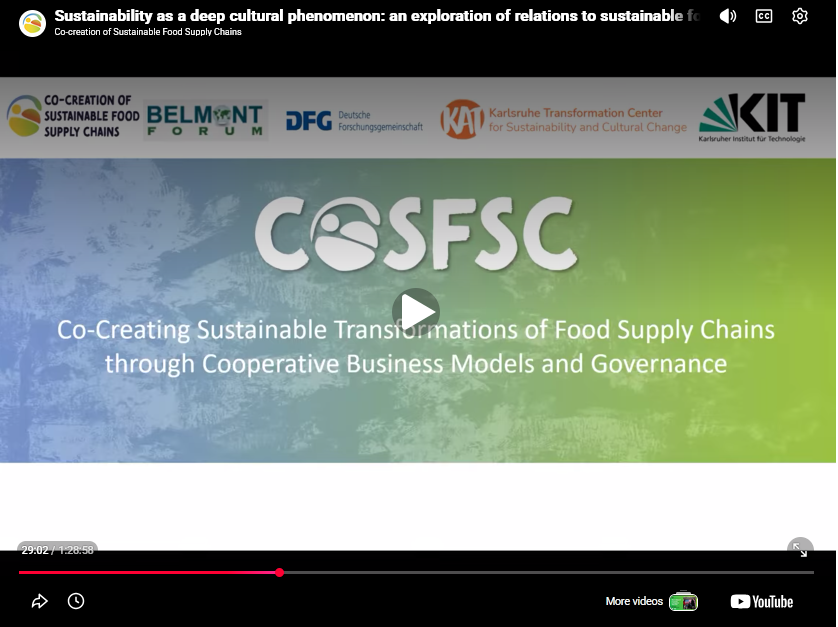
For those of you who missed our webinar on Deep Sustainability, or had to leave early, please find the recording here:
Description
Sustainability as a deep cultural phenomenon: an exploration of relations to sustainable food supply.
This webinar presents an exploratory approach to understanding sustainability as a deep cultural phenomenon, focusing on how individuals relate to food and food supply chains across different cultural backgrounds. Drawing on narrative interviews enriched by photo elicitation, the study uncovers how values, emotions, perceptions, and personal meanings shape sustainability practices.
The session begins with an introduction to the conceptual framework, followed by the presentation of empirical insights from the interviews. Particular attention is given to identifying possible “deep leverage points” for transformation, those underlying cultural dimensions that influence sustainable behavior (Meadows 1999; Parodi 2024; Schäpke 2024). A reflective discussion on the methodological approach and key learnings will follow, before opening the floor for questions and exchange with participants.
Bios
Oliver Parodi, philosopher, cultural scientist, and civil engineer, is head of the Karlsruhe Transformation Center for Sustainability and Cultural Change and senior researcher at KIT-ITAS, Germany. He is initiator and head of the Real-world Lab Quartier Zukunft – Labor Stadt (since 2012) and also likes to explore “Personal Sustainability” and “Cultures of Sustainability”.
Pia Laborgne is a sociologist and sustainability researcher at the Karlsruhe Transformation Centre for Sustainability and Cultural Change (KAT) at KIT-ITAS in Karlsruhe, Germany. Her work focuses on urban sustainability transformations with a focus on energy and food systems
Eva Wendeberg, is a geoecologist and works in transdisciplinary sustainability research, transformative education, and sustainability assessment at the Karlsruhe Transformation Centre (KAT) at KIT-ITAS. As a yoga teacher, she also brings a personal practice of reflection that fits well with the approach of deep sustainability and holistic transformation.
Aylin Topal is vice chair of the Political Science and Public Administration Department at Middle East Technical University in Ankara. She seeks to connect empirical research with deeper questions of ecological crisis, social justice, and transformative pathways toward deep sustainability.
Read more at https://www.sustainablefood-sc.org/